Stitched, Shaped, and Shredded: The American Craftspeople Building Your Favorite Water Gear
You probably don't think much about your wetsuit while you're paddling out at dawn. You're focused on the swell, the lineup, the cold bite of the water hitting your face. But somewhere — maybe in a warehouse in San Clemente, a workshop in Portland, or a small manufacturing floor in Minnesota — someone spent months figuring out exactly how that suit should fit, flex, and keep you warm. These are the people we almost never talk about, and honestly, that's a shame.
America's water sports scene is booming. Participation in everything from surfing to whitewater kayaking to open-water swimming has surged since 2020, and the gear market has followed right along. But behind the glossy product pages and sponsored athlete content is a surprisingly rich world of designers, engineers, shapers, and sewers who are doing the real heavy lifting — often without much fanfare.
The Shapers Still Doing It by Hand
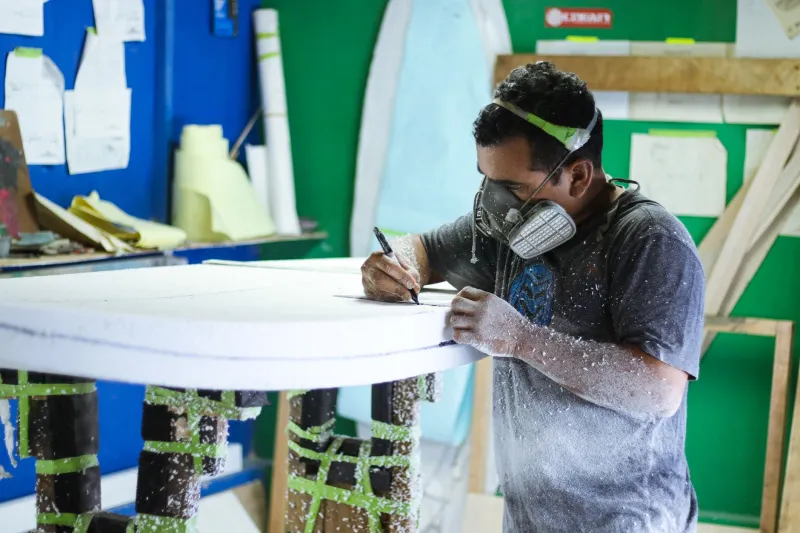
Board shaping is one of those crafts that tech keeps threatening to automate, but never quite manages to kill. Walk into a shaping bay in Oceanside or Santa Cruz and you'll still find someone running a planer over a foam blank, reading the curve of a rail with their fingertips rather than a sensor.
Take guys like Marcus Delray, a third-generation shaper out of the Gulf Coast who learned the trade from his grandfather and now produces around 400 custom boards a year. "A machine can cut a shape," he says, "but it can't feel the way foam responds differently depending on the density or the humidity that day. That's still a human thing."
Delray represents a broader movement of small-batch American shapers who've actually gained ground in recent years, partly because global supply chains got so messy that importing finished boards became a logistical nightmare. When overseas factories slowed down or shut down entirely during the pandemic disruptions, some shops started looking closer to home — and discovered that domestic craftsmanship had never really gone anywhere.
What Supply Chain Chaos Actually Changed
The years between 2020 and 2023 were rough for gear brands of all sizes. Foam blanks got scarce. Fiberglass prices jumped. Shipping containers sat offshore for weeks. Brands that had offshored most of their production suddenly found themselves scrambling, and a handful of them made a decision that surprised even their own teams: they started building more stuff stateside.
It wasn't purely idealistic. It was often a survival move. But the side effect was genuinely interesting — a reinvestment in American manufacturing talent that had been quietly eroding for decades.
Wetsuit brands started working with domestic neoprene suppliers they'd ignored for years. Paddle companies brought cutting and assembly back to US workshops. Kayak manufacturers who'd been importing hulls from overseas retooled facilities in places like Washington State and Vermont to handle more of the production themselves.
"We didn't plan to become a made-in-America brand," admits one product director at a mid-sized paddle sports company. "We planned to survive. But now that we've done it, we're not going back. The quality control alone has been worth it."
The Engineers You've Never Heard Of
Not everyone in this world is a salty shaper with foam dust on their shirt. Some of the most interesting people building water sports gear are materials scientists and mechanical engineers who came from completely different industries.
One of the cooler examples is the crossover talent flowing in from aerospace and medical device manufacturing. Engineers who once worked on composite materials for aircraft or flexible polymers for surgical equipment have found a natural home in high-performance water gear. The technical demands aren't that different — you need materials that are lightweight, durable, and able to perform under unpredictable stress.
A wetsuit designed for serious cold-water diving, for instance, requires the same kind of layered thermal engineering you'd find in protective gear for extreme environments. And the seam-sealing technology in a dry suit? That's legitimately sophisticated stuff, developed by people who think hard about failure modes and edge cases most of us will never encounter.
The Buy-American Wave (and Why It's More Than Marketing)
There's a growing consumer push to buy American-made water sports gear, and it's worth taking seriously — even if it comes with a price tag that makes you wince a little.
The argument isn't just patriotic. Domestically produced gear tends to come with better accountability around labor practices, shorter supply chains that reduce environmental impact, and often more responsive customer service when something goes wrong. When your board snaps or your suit develops a leak, being able to call the person who made it — or even drive to their shop — is genuinely valuable.
Brands like Grain Surfboards in Maine (they build wooden boards, which is its own whole rabbit hole) and WRSI helmets out of Vermont have built loyal followings partly by leaning into their American origins and the craft behind their products. Consumers who care about this stuff are willing to pay more, and they tend to become the kind of customers who stick around and evangelize.
That said, it's not a simple picture. Some gear categories are almost impossible to produce cost-effectively in the US right now. The infrastructure for manufacturing certain types of fins or specific hardware just doesn't exist domestically at scale. Honest brands will tell you that — and the good ones are transparent about which parts of their supply chain are domestic and which aren't.
Landlocked and Building for the Coast
One of the more unexpected parts of this story is how much water sports gear is built nowhere near the water. Ohio has more than a few kayak component suppliers. Tennessee has become a quiet hub for outdoor gear manufacturing of various kinds. And some of the best wetsuit stitching operations in the country are nowhere near a coastline.
This matters because it means the workforce behind your gear is genuinely national — not just a coastal phenomenon. These are manufacturing jobs in communities that don't always get associated with outdoor recreation, and they represent a real economic link between America's heartland and its adventure culture.
Give Credit Where It's Due
Next time you're suiting up, take a second to think about the chain of hands that got that gear to you. The shaper who dialed in the rocker on your board. The engineer who figured out how to keep the seams from leaking in 45-degree water. The seamstress who ran the same stitch pattern a thousand times to get it right.
They're not on the podium. They're not in the sponsor reel. But they're the reason you get to do what you do — and that deserves at least a little recognition.