From Couch to Current: How Smarter Gear Is Pulling More Americans Into the Water
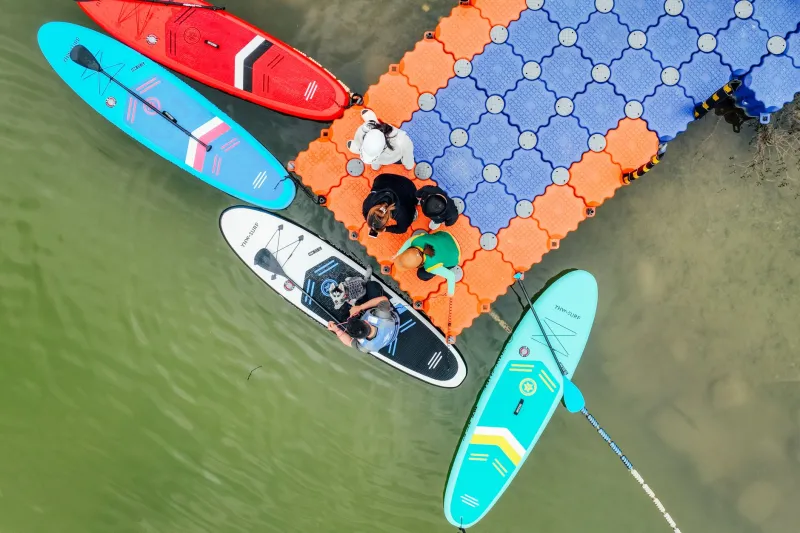
For a long time, water sports carried an unspoken cover charge. You needed the right board, the right wetsuit, the right instructor — and ideally, the right zip code. But something has shifted in the last few years, and it's happening faster than most people realize. A new generation of technology is quietly dismantling those old barriers, and the result is a whole lot of first-timers finding their footing on the water.
This isn't just a gear story. It's a story about who gets to participate.
The Price Problem Is Getting Solved
Let's start with the obvious one: cost. Historically, outfitting yourself for surfing, kayaking, or stand-up paddleboarding could set you back hundreds — sometimes thousands — of dollars before you ever touched the water. That math didn't work for a lot of American families.
But manufacturing advances and increased market competition have pushed prices down dramatically. Inflatable SUP boards, for example, have dropped from premium-only territory into the $300–$500 range for quality beginner setups. Brands like Bluefin and iROCKER have made it possible to stuff a full paddleboard into a backpack without sacrificing durability. For someone in a landlocked state who wants to take their gear to a lake on weekends, that's a genuine game changer.
"We're seeing customers from places like Oklahoma and Kansas who never thought paddleboarding was for them," says one gear retailer based out of Denver who works with both brick-and-mortar shops and online distributors. "The inflatable market basically created a new category of water sports participant."
Entry-level kayaks have followed a similar arc. Where sit-on-top recreational kayaks once felt like a compromise, today's affordable options come with ergonomic seats, UV-resistant materials, and stable hull designs that genuinely perform well for beginners. The floor has risen while the price ceiling has dropped.
Wearables That Actually Know What They're Doing
If affordable hardware opened the door, wearable tech is the thing making people feel confident enough to walk through it.
Garmin's Descent series and similar dive-focused smartwatches now offer real-time depth tracking, heart rate monitoring, and GPS mapping in a package that's water-rated for serious use. But it's not just the dive community benefiting. Surf-specific wearables from brands like Xensr and Rip Curl's Search GPS have given recreational surfers data that was once reserved for professionals — wave count, speed, distance traveled, even session duration.
For newer athletes, that data isn't just cool. It's motivating. Seeing your progress tracked in an app, watching your wave count climb week over week, gives the kind of feedback loop that keeps people coming back. Coaches who work with adult beginners say the impact has been noticeable.
"I have students who are way more engaged now because they can actually see their improvement," says a surf instructor based in Virginia Beach who teaches adult beginners through a community recreation program. "Before, a lot of people would take a couple lessons and drift away. Now they're checking their stats between sessions and asking better questions."
AI and Safety: The Quiet Revolution
Perhaps the most underappreciated development in water sports tech is what's happening on the safety side. For many potential participants — especially parents, older adults, and people new to open water — fear has always been a real obstacle. And that fear isn't irrational. Open water carries genuine risks.
But a new class of AI-assisted safety devices is changing that calculation. Inflatable personal locator beacons (PLBs) have gotten smaller and smarter. Devices like the Ocean Signal rescueME PLB1 can be clipped to a life vest and will automatically trigger an alert if a person enters the water unexpectedly. Some newer models use accelerometer data and machine learning to distinguish between an intentional swim and an emergency — cutting down on false alarms while improving response time when it actually matters.
For parents introducing kids to kayaking or paddleboarding, these devices offer a layer of reassurance that simply didn't exist five years ago. And for solo adventurers exploring remote stretches of coastline or backcountry lakes, they're increasingly considered standard kit.
Drone technology is also playing a role. Lifeguard programs in cities like Los Angeles and Miami are piloting AI-assisted drone surveillance systems that can flag struggling swimmers faster than a human observer and drop flotation devices before a rescue team hits the water. While that's an infrastructure story rather than a consumer gear story, it signals where the broader safety ecosystem is headed — and it's making water environments measurably safer for everyone.
Learning Has Changed, Too
It's worth noting that the gear revolution doesn't exist in isolation. The way people learn water sports has evolved right alongside the equipment. YouTube tutorials, app-based coaching platforms, and virtual reality training tools are all lowering the knowledge barrier that used to require expensive in-person instruction.
Apps like Surfline don't just show you wave conditions anymore — they offer video analysis tools that let you review your own footage with overlaid data. For a self-directed learner on a budget, that kind of feedback is invaluable.
Community programs are also expanding access in ways that gear alone can't accomplish. The National Park Service, YMCA chapters, and local surf nonprofits like Stoked Mentoring have all leaned into the democratization wave, offering subsidized lessons and equipment rentals in communities that have historically been underrepresented in water sports culture.
What This Means for the Sport
There's a version of this story that focuses entirely on gadgets. But the more interesting angle is what all of this adds up to culturally. Water sports in America have long carried an image problem — associated with expensive vacations, coastal elites, and a very specific demographic. That image is cracking.
When a family from suburban Ohio can load up an inflatable SUP and spend a Saturday on a reservoir, when a 55-year-old in Texas can track her kayaking progress on a smartwatch, when a teenager in an inland city can learn to read waves through an app before they ever see the ocean — the sport changes. It gets bigger, more diverse, and honestly, more interesting.
The gear is smarter. The price is lower. The safety net is stronger. And for a lot of Americans who assumed the water wasn't really for them, it turns out it kind of is.
All they needed was a slightly better invitation.