Sink or Swim Together: What the Water Reveals About Your Relationship
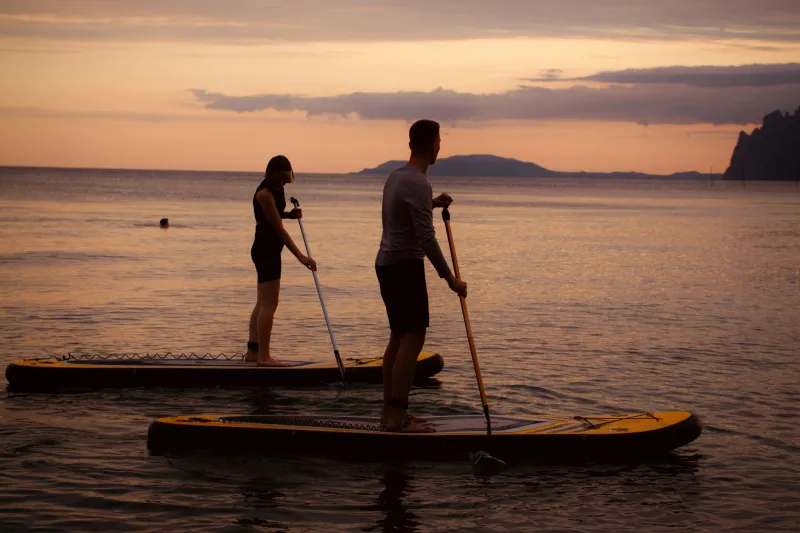
There's a reason couples therapists sometimes joke that you can learn more about a relationship in one kayaking trip than in six months of sessions. Water has a way of stripping things down. No distractions, no phones, no comfortable routines to hide behind — just two people, a body of water, and whatever they've been carrying around.
For better or worse, that's exactly what's drawing more American couples to the water. And what they find there isn't always what they expected.
The Paddle That Started a Fight — and a Breakthrough
Ashley and Marcus from Austin, Texas, had been together for four years when a friend suggested they try stand-up paddleboarding on Lady Bird Lake. Ashley was immediately into it. Marcus, not so much. He wobbled, fell in twice in the first ten minutes, and spent the better part of an hour watching Ashley glide ahead of him without looking back.
"I felt embarrassed, and then I felt angry that I felt embarrassed," Marcus says. "And then I realized I was angry at her, which made zero sense. She didn't do anything wrong."
That frustration led to a longer conversation on the drive home — one that eventually surfaced a pattern they'd never quite named before: Ashley tended to move ahead without checking in, and Marcus tended to fall behind rather than ask for help. They'd been playing out that dynamic for years in their relationship. It just took a paddleboard to make it visible.
They still paddleboard most weekends. They're engaged now.
Why Adventure Puts Relationships Under a Microscope
Relationship therapist Dr. Carla Simmons, who practices in San Diego and works with a lot of surf-adjacent couples (her words), says this kind of story isn't unusual. "Adventure sports create what we call 'high-activation states' — your nervous system is engaged, your guard is down, and your instincts take over," she explains. "You find out really quickly how someone responds to challenge, to failure, to uncertainty. That's incredibly revealing."
She's seen couples come back from a single whitewater rafting trip ready to do the real work in therapy. She's also seen couples realize, after a weekend on the water, that they're genuinely not compatible — not because the water broke them, but because it showed them something that was already true.
"The water doesn't cause problems," she says. "It just makes them harder to ignore."
The Instructor's View From the Shore
Water sports instructors have a front-row seat to all of it. Jake Ferreira has been teaching surf lessons in Santa Cruz for over a decade, and he's learned to read couples the moment they walk up to the beach.
"You can tell a lot just from how they talk to each other during the intro," he says. "Some couples are immediately encouraging — they're laughing, hyping each other up. Others, one person is already kind of checking out, or one is taking over and explaining things to the other one even though neither of them knows anything yet."
He's seen couples fall more in love in the water. He's also watched a few quietly implode. One pair, he recalls, had a blowout argument in the parking lot after a lesson because one partner had been "coaching" the other nonstop — unsolicited, increasingly critical — for the full two hours. "She finally just said, 'I didn't ask you to fix me.' And honestly? That was the lesson."
Jake now includes a brief pre-lesson chat about communication styles. It's not therapy, but it helps.
When the Water Becomes a Safe Space
Not every story is a cautionary tale. For plenty of couples, getting on the water together has become something genuinely transformative — not because it was dramatic, but because it was different.
There's something about being out on open water that loosens people up. Maybe it's the movement, or the fact that you're literally not making eye contact when you're both facing forward on a tandem kayak. Whatever it is, couples consistently report that conversations happen on the water that they struggle to have at home.
Dr. Simmons has actually started recommending "active conversations" to some of her clients — walking, paddling, or swimming side by side rather than sitting across from each other. "When you're in motion, facing the same direction, the dynamic shifts. It feels less like a confrontation and more like you're both moving toward something together. That's not just metaphor — it changes how people communicate."
For couples dealing with stress, disconnection, or just the grind of everyday life, a few hours on the water can act like a reset button. Not a fix, but a starting point.
The Ones Who Didn't Make It
It would be dishonest to only tell the love stories. Some couples genuinely discover, out on the water, that they want different things — not just from their Saturday mornings, but from their lives.
Rachel from Denver found that out on a kayaking trip on the Colorado River with her then-partner. "He hated it the whole time. Like, visibly miserable. And I was having the best day of my life," she says. "I looked at him and thought, 'We want completely different things.' That was a hard thing to sit with for six hours on a river."
They broke up a few months later. Rachel now kayaks almost every weekend and recently joined a local paddling club where she's met some of her closest friends. "The water showed me who I was," she says. "That was worth it, even if it hurt."
What to Take With You Before You Launch
If you and your partner are thinking about hitting the water together — whether it's your first time or your fiftieth — a little intention goes a long way. Instructors and therapists alike suggest a few things:
Talk about expectations beforehand. Who's the stronger swimmer? Who's done this before? What does a good day look like for each of you? Getting on the same page before you get in the water prevents a lot of friction once you're out there.
Agree to check in. Whether it's a thumbs up from across the water or a quick pause mid-paddle, checking in with each other keeps you connected even when you're not side by side.
Let each other struggle a little. The instinct to jump in and fix things for your partner is natural, but learning to let someone work through a challenge — and trusting them to ask for help when they need it — is one of the more valuable things the water can teach you.
Debrief after. The drive home or the meal afterward is prime time for the kind of conversation the water opened up. Don't skip it.
The water has always had a way of telling the truth. Whether that truth is "you two are solid" or "we need to talk" — it's probably worth knowing.
Some of the best relationships are the ones that got tested by a wave and came out the other side, a little soaked, a little more honest, and still paddling together.